Monetary Policy Report for July 2026
The Monetary Policy Report presents the Bank's technical staff's analysis of the economy and the inflationary situation and its medium and long-term outlook. Based on it, it makes a recommendation to the Board of Directors on the monetary policy stance. This report is published on the second business day following the Board of Directors' meetings in January, April, July, and October.
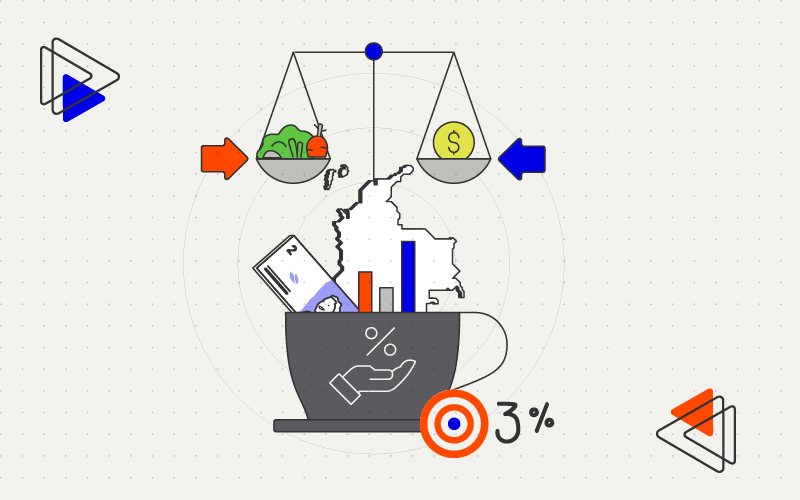
During the second quarter of 2026, inflation continued to rise, moving further from the 3% target, driven by higher labor costs, elevated household and public-sector spending, and higher food prices. At the same time, the Colombian economy recorded stronger growth, boosted primarily by consumption and investment in machinery and equipment. Inflation expectations remain high, and spending levels continue to exceed those the economy can sustain without generating additional inflationary pressures. During the remainder of 2026, prices are expected to rise before gradually moderating in 2027. In this environment, Banco de la República remains committed to taking the necessary measures to ensure the gradual convergence of inflation toward the 3% target.

Inflation continued to rise during the second quarter, moving further away from the 3% target, driven by higher labor costs, robust consumption, and supply disruptions that primarily affected food prices. Looking ahead, these factors are expected to continue exerting upward pressure on prices during the remainder of 2026 and to gradually moderate in 2027.
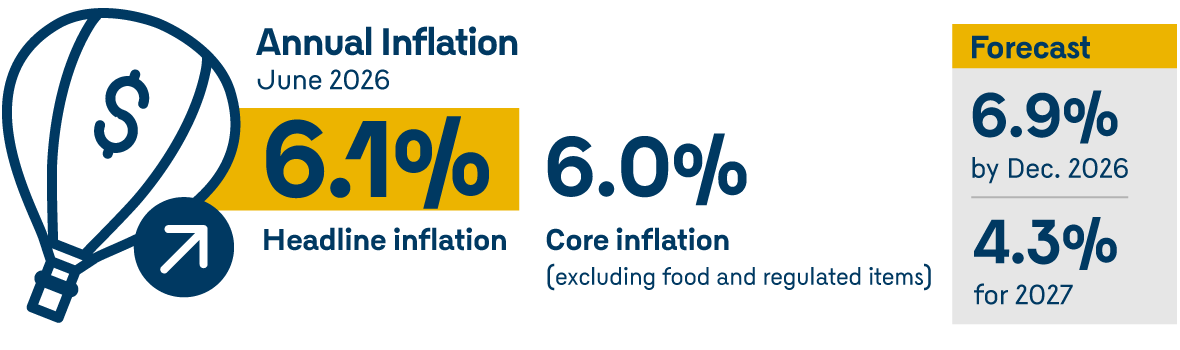
- In June, prices rose to 6.1% year-on-year, up from 5.6% observed in March. A similar pattern was observed in the less volatile components of the consumer basket (excluding food and regulated items). As a result, inflation continued to move further away from the 3% target.
- The faster pace of inflation was driven by significant increases in wages and other labor costs, continued strong spending levels in the economy, and factors affecting agricultural supply, including the lagged effects of rainfall on crops, work stoppages, and higher production costs.
- Some factors helped moderate these pressures, including the recent appreciation of the peso against the U.S. dollar and smaller increases in food-away-from-home prices.
- The technical staff’s projections indicate that inflation is expected to continue rising through the remainder of 2026. This reflects the effects of higher labor costs, expected increases in food prices, the potential impacts of an El Niño event, rises in some public utility tariffs, and continued robust household spending. Beginning in 2027, price increases are projected to gradually ease and converge towards the 3% target over the following two years, partly as a result of Banco de la República’s monetary policy actions.
- These projections are subject to a high degree of uncertainty. The main factors that could affect the future path of inflation include weather conditions, international conflicts, developments and the outlook for fiscal policy, and changes in the prices of certain regulated items, such as gasoline and energy.
Economic growth in Colombia accelerated in the first quarter of 2026, mainly due to higher household and public-sector spending, and investment in machinery and equipment. Although economic activity is expected to continue to grow over the coming quarters, this expansion is projected to ease relative to the recent pace. This reflects, in part, a slowdown in the factors that have been boosting economic activity in recent months, amid persistent uncertainties both domestically and abroad.
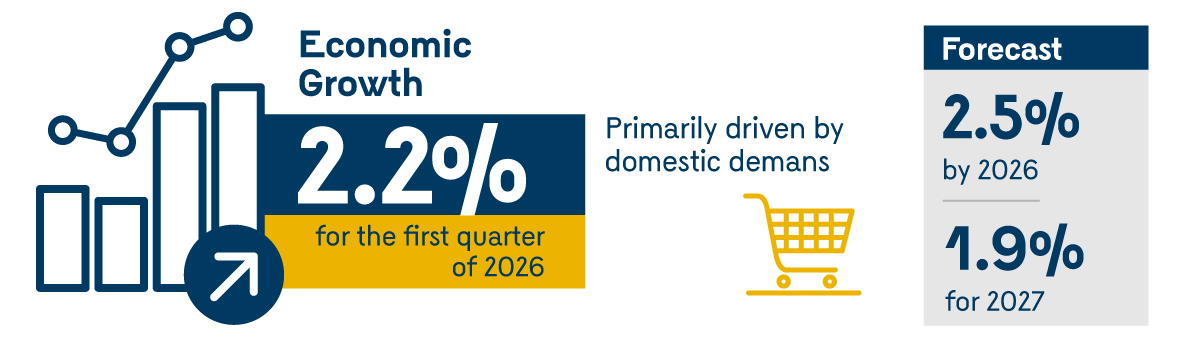
- During the first quarter of 2026, the Colombian economy grew by 2.2% annually, reflecting strong performance in both private and public consumption, as well as in certain investment components, predominantly machinery and equipment.
- Household spending remained strong, principally noted in the purchase of durable goods such as vehicles, motorcycles, computers, and household appliances.
- Investment increased, driven by higher purchases of machinery and equipment, although construction activity remained weak.
- The labor market remained favorable as employment continued to increase and the unemployment rate remained at historically low levels.
- Economic activity is expected to continue growing in 2026 and 2027, albeit at a more moderate pace, supported by favorable terms of trade, the gradual recovery of investment—particularly in infrastructure—and the contribution of international tourism.
- The Colombian economy continues to face significant uncertainty related to the international environment, domestic fiscal conditions, and potential weather events that could affect production.
The Board of Directors of Banco de la República remains committed to ensuring the gradual convergence of inflation to the 3% target. This objective is particularly important at a time when prices are rising rapidly, and household and government spending continues to exceed levels consistent with the economy’s productive capacity.
- Inflation has increased and remains significantly above the target.
- Economic activity and the labor market continue to show strong dynamism. This supports the growth of domestic spending and may contribute to inflation remaining elevated.
- There is considerable uncertainty surrounding the factors that will affect prices and economic activity going forward. In particular, the main risks relate to weather events, including the intensity and duration of potential El Niño event effects, international conditions, and domestic fiscal policy.
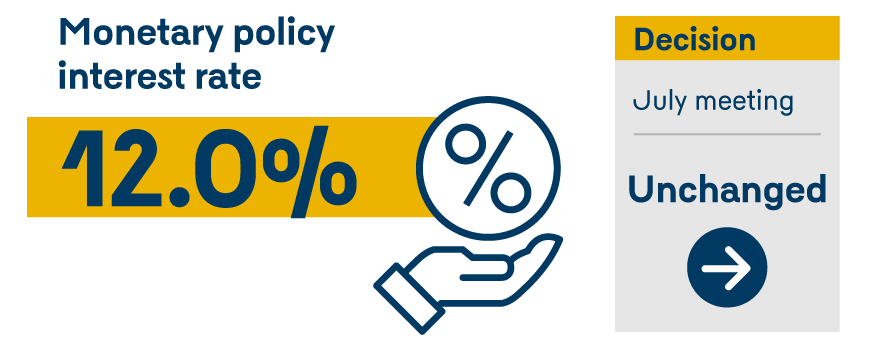
- Taking these considerations into account, the Board of Directors decided at its June meeting to increase the monetary policy interest rate by 75 basis points and, in July, maintained a restrictive monetary policy stance, leaving the rate unchanged at 12.0%.
- Future monetary policy decisions will depend on new information regarding prices, economic activity, and the evolution of the risk factors described above.
- Through these decisions, the Bank seeks to ensure the gradual convergence of inflation to the 3% target within a reasonable timeframe.
Monetary Policy Presentation (only in Spanish)
Index of Boxes from the Report
 Box 1. Determinants of Nonfood, Nonregulated Goods Inflation in Colombia: Evidence from a VAR under an Open-Economy Phillips Curve Approach
Huertas-Campos, Carlos Alfonso
Salazar-Silva, Marlon
 Reports
 Presentations (only in Spanish)
 Boxes
Boxes