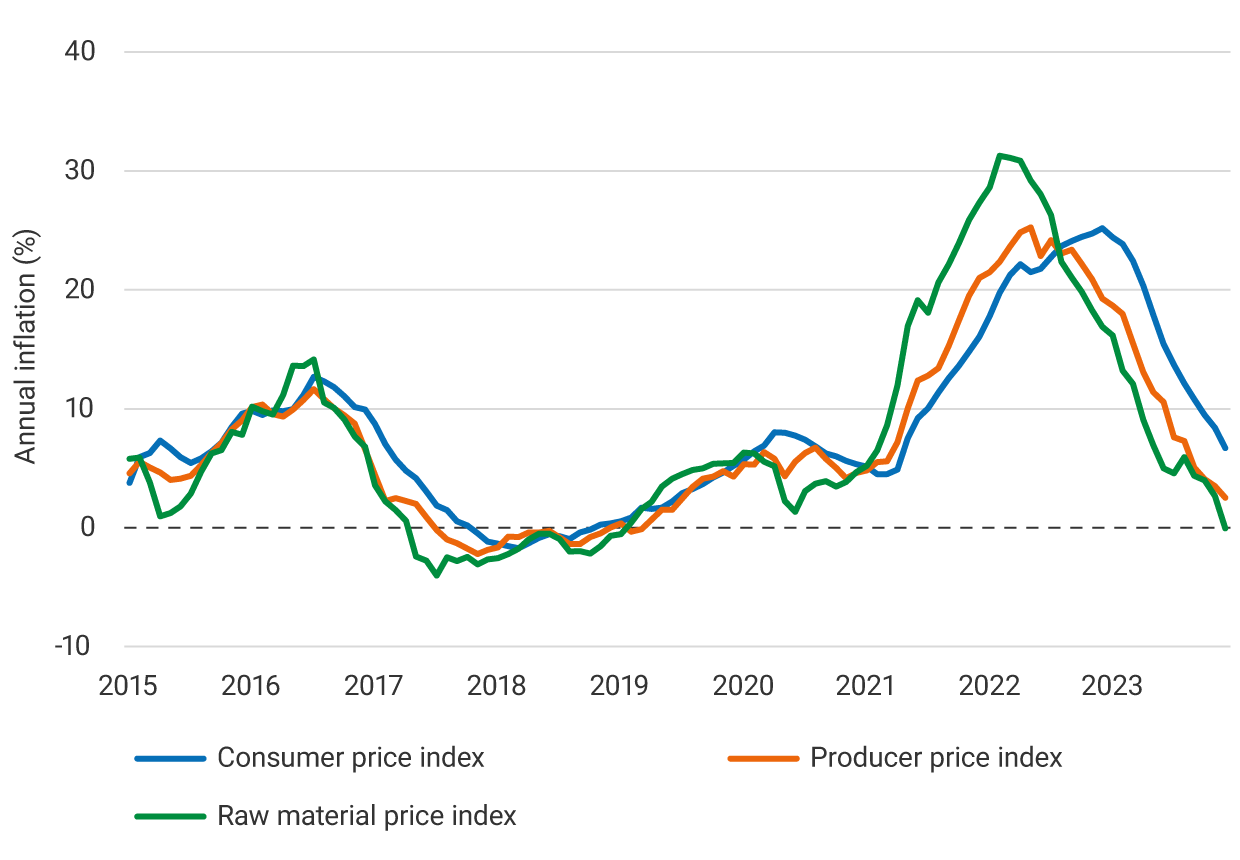
As shown in Graph 1, in the period following the pandemic, the price index for raw materials used in Colombia’s processed food production sector rose substantially, reaching annual growth of 31% in January 2022. This index includes the prices of inputs such as wheat, corn, and soybeans, whose prices increased in global markets due to various external factors. Consequently, prices of processed foods—such as meat, flour, oils, dairy products, and chocolate—increased at rates not seen in the country for decades. As the graph shows, annual inflation for these products peaked at over 20%, nearly four times its pre-pandemic average.
In a recent research paper, researchers at Banco de la República (the Central Bank of Colombia), Jorge Flórez, Margarita Gáfaro, Alejandra González, and Sebastián Vélez examine what proportion of these increases in raw material costs is passed through to processed food prices in Colombia. The paper, published in the Working Papers on Economics series (Borradores de Economía), also examines how quickly this pass-through occurs and how it varies depending on market characteristics.
The study finds that increases in raw material costs are passed through to food prices gradually and incompletely. In particular, a 1.0% increase in raw material prices raises the prices charged by firms for these products by 0.6%, on average. Two-thirds of the adjustment occurs in the first month, and the effect is complete five months later. According to these estimates, raw material costs account for nearly 84% of the increase in producer prices for processed foods between March 2021 and March 2022.
A second finding of the research is that the pass-through of these cost shocks is lower in less competitive sectors. In more competitive sectors, such as meat processing and grain and starch milling, a 1.0% increase in raw material costs raises producer prices by 0.7%. In less competitive sectors, such as sugar refining, bakery product manufacturing, and chocolate and confectionery production, the same shock raises prices by only 0.2. In other words, lower competition in some sectors partially mitigated the cost shock.
This result may seem counterintuitive, but it has a clear economic explanation. Firms with market power charge prices above their economic costs, but lose sales as they raise their prices. Therefore, when their costs increase, they raise prices less than proportionately to maximize profits. Similarly, if their costs fall, firms reduce prices less than proportionately to protect their margins. By contrast, in competitive markets, firms must fully pass changes in costs through to final prices, or they would incur economic losses and must exit the market. This implies that prices in less competitive markets respond less to cost shocks, which is precisely what the research shows occurs in processed food markets in Colombia.