Servicios
|
This paper examines trends in banknote printing during the period 2000-2005 for a crosssection of 56 central banks. It was identified that central banks have implemented new strategies to increase efficiency in the production of banknotes, primarily due to the increase in the demand for currency in…
|
|
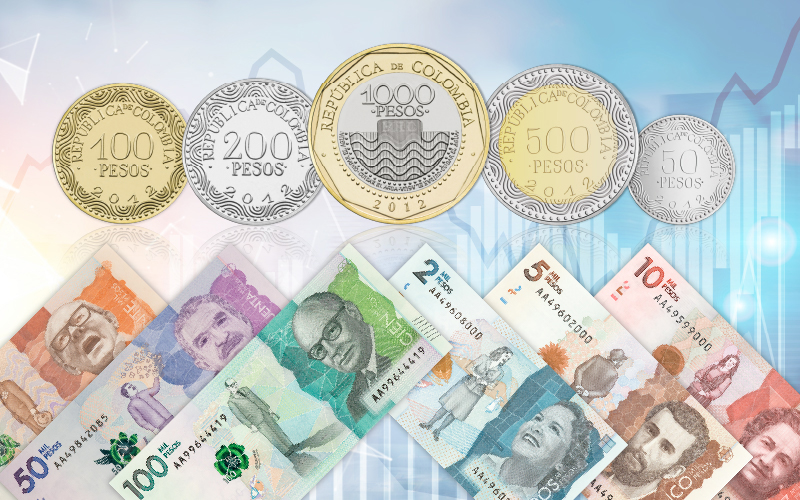
The central bank issues the country’s currency in the form of banknotes and coins. This is an exclusive function that may not be delegated. Consequently, the production, issue, supply and destruction of all Colombian currency is solely the responsibility of Banco de la República.
|
|
In complex systems, homogeneity (i.e. lack of diversity) has been documented as a source of fragility. Likewise, financial sector’s homogeneity has been documented as a contributing factor for systemic risk. We assess homogeneity in the Colombian case by measuring how similar banks are regarding…
|
|
The opinions contained in this document are the sole responsibility of the author and do not commit Banco de la República or its Board of Directors.
|
|
A recent document of the journal Ensayos sobre Política Económica (ESPE) from Banco de la República (the Central Bank of Colombia) contains the results of multiple analyses of the effect of the minimum wage on the labor market, income distribution, public finances, prices, and the economic activity…
|
|
General Objective“BanRep desde el lente” is a contest of videos that promotes research on high school students. It aims to instill in young people passion for understanding what happens in the economy and how it is related to their lives. Technology, and social networks are used as learning tools…
|
|
Banrep Interviews is a new space to learn about the perspectives of the relevant people who are part of Banco de la República (the Central Bank of Colombia – Banrep). It is also a means to get to know a little more about them. The first Banrep Interviewee is Bibiana Taboada, a member of the…
|
|
Complete tittle: The Banco de la Republica Leaves the Benchmark Interest Rate Unaltered and Continues he International Reserve Purchase ProgramIn their meeting today, the Board of Directors of the Banco de la Republica decided to leave the benchmark interest rate at 3.25%. In making this decision,…
|
|
Annual inflation increased marginally to 5.3% in February, following a three-month period of stability at 5.2%. The most significant increases were observed in the prices of processed foods and certain regulated items, including gas and transportation. Core inflation (excluding food and regulated…
|
|
Annual inflation dropped from 6.1% to 5.8% between August and September. Leading this decline was the regulated items group, whose annual inflation decreased by one percentage point from 11.1% to 10.1%, mainly driven by the fuels component. Food inflation also registered a significant drop (from 3.…
|
|
Annual inflation fell in August to 6.1%, below forecasts by the Bank’s technical staff and the market. This easing was partly driven by lower-than-expected prices in the food basket, with food inflation falling from 5.3% to 3.4% between July and August, primarily resulting from an ample supply of…
|
|
Headline inflation rose again in September for the third consecutive month, reaching 5.2%, a level last seen at yearend 2024. Core inflation, excluding food and regulated items, remained at 4.8%.Inflation expectations, as measured by surveys and the public debt market, increased in October. Median…
|
|
In its policy discussion, the Board of Directors considered the following factors:
|
|
Annual inflation in June fell to 4.8% from 5.1% in May, chiefly as a result of waning inflation in the food and regulated baskets. Food inflation fell from 4.7% to 4.3%, mainly due to a reduction in perishables inflation. Regulated products inflation fell from 6.3% to 5.5%, driven by lower…
|
|
Between April and May, annual inflation edged down slightly—from 5.2% to 5.1%—while core inflation (excluding food and regulated items) fell mildly from 4.9% to 4.8%. This modest deceleration reflects rigidity in key baskets such as food and services, offset by a small rebound in goods inflation.…
|
|
Annual inflation resumed its downward trend between February and March, declining from 5.3% to 5.1%. By components, results were mixed: inflation for goods and food increased, while that for regulated items and services decreased. Core inflation—excluding food and regulated items—continued to…
|
|
Headline inflation stood at 5.1% in August, while core inflation excluding food and regulated items ended the month at 4.8%, exceeding the technical staff’s forecasts. The largest deviation was seen in food, primarily in perishable items and in the international prices of certain foods and…
|
|
Headline inflation in December stood at 5.1%, slightly lower than the 5.2% figure for year-end 2024. Core inflation - which excludes food and regulated items - rose from 4.85% to 5.02% between November and December, and it was also at a level close to that recorded in December 2024 (5.15%). These…
|
|
In December, annual inflation remained at 5.2%, unchanged from the levels seen in November. Monthly inflation (0.46%) driven by food price inflation, which climbed from 2.3% to 3.3%, exceeded the expectations of both the market (0.40%) and the technical staff (0.34%). Core inflation, excluding food…
|
|
In November, annual inflation fell to 5.2%, below the 5.4% seen in October. Core inflation, excluding food and regulated items, remained close to 5.4%, as a result of persistent inflationary pressures in the services sub-basket (7.3%). The latter is due to upward pressures from the food away from…
|
|
Annual inflation remained unchanged in May at 7.2%, while core inflation (excluding food or regulated items) fell from 6.4% to 6.1%. Annual food inflation was slightly higher than expected, increasing from 3% to 4.4%, owing to a rebound in the prices of some perishable foods whose impact from the…
|
|
Annual inflation rose slightly from 7.16% to 7.18% between May and June. Core inflation excluding food and regulated items decreased from 6.1% to 6.0%, aligning with the technical staff's forecasts. Annual food inflation continued to increase, from 4.4% to 5.3%, driven by climatic factors affecting…
|
|
In March, annual headline inflation reached 7.4%, completing 12 months of consecutive declines from its March 2023 peak of 13.3%. Likewise, inflation excluding food and regulated items significantly decreased and stood at 6.8% in March. The reduction in annual inflation was largely driven by…
|
|
Annual headline inflation continued its downward trend during February, standing at 7.7% and exhibiting a cumulative drop of 1.5 percentage points (pp) during the first two months of the year. Likewise, annual inflation, excluding food and regulated items, had a 1.2 pp drop which, coupled with a…
|
|
Annual consumer price inflation decreased in May for the second consecutive month to 12.4%, fronted by a reduction in the annual food price inflation rate from 27.8% in December 2022 to 15.7% in May 2023. In contrast, increases were observed in the inflation of regulated items resulting from…
|