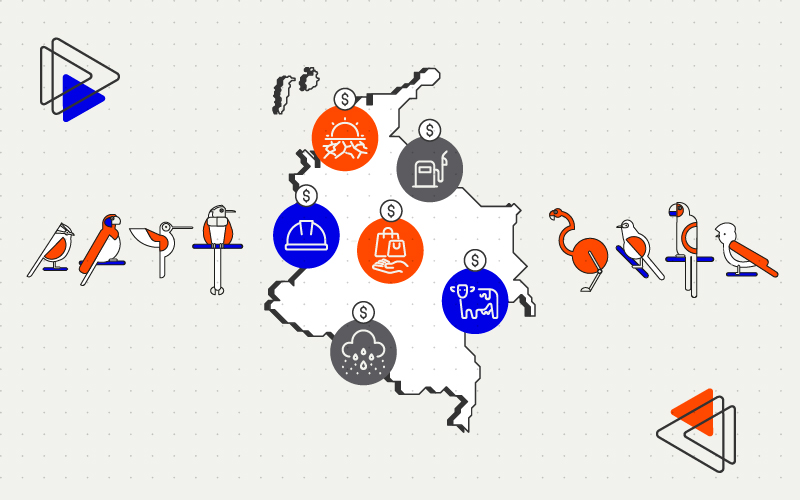

GDP is a key measure of economic output, but departmental figures are published with a lag. Therefore, it is useful to complement them with more recent information. In this context, the BER offers a timely view of the regional economy based on analysis and interpretation of indicators from different sectors. Because data collection occurs about a month before publication, the BER provides a near-real-time view.
Publication date
When we hear that the economy has grown, we may assume every household, business, and region in the country experienced the same narrative. However, that’s often not the case. A good harvest can boost one region’s performance, while construction challenges may slow down another’s. To really understand a country’s economy, we need to look not only at its overall growth rate, but also at where, how, and why it’s growing.
To identify these differences, Banco de la República’s Regional Economic Bulletin (BER for its Spanish acronym) analyzes the quarterly economic activity of the country’s seven regions: Bogotá-Cundinamarca, Caribbean Coast, Central Coffee Region, Northwest, Northeast, Southeast, and Southwest. This classification allows us to observe how territories with different productive structures and economic dynamics change.
To better understand the role of the BER, this blog post examines the most relevant trends and facts for the regions in the second quarter of 20261.
Household consumption once again took center stage
Household consumption was a key factor in this quarter’s growth. Sales of durable goods such as cars, motorcycles, televisions, and technological equipment increased in several regions, driven mainly by the World Cup. This behavior, in addition to boosting trade, also created demand for other activities, including transportation, commerce, financial services, insurance, maintenance, and distribution. Therefore, consumption was a key driver of growth because it fueled multiple sectors of the economy at once.
(second quarter of 2026)
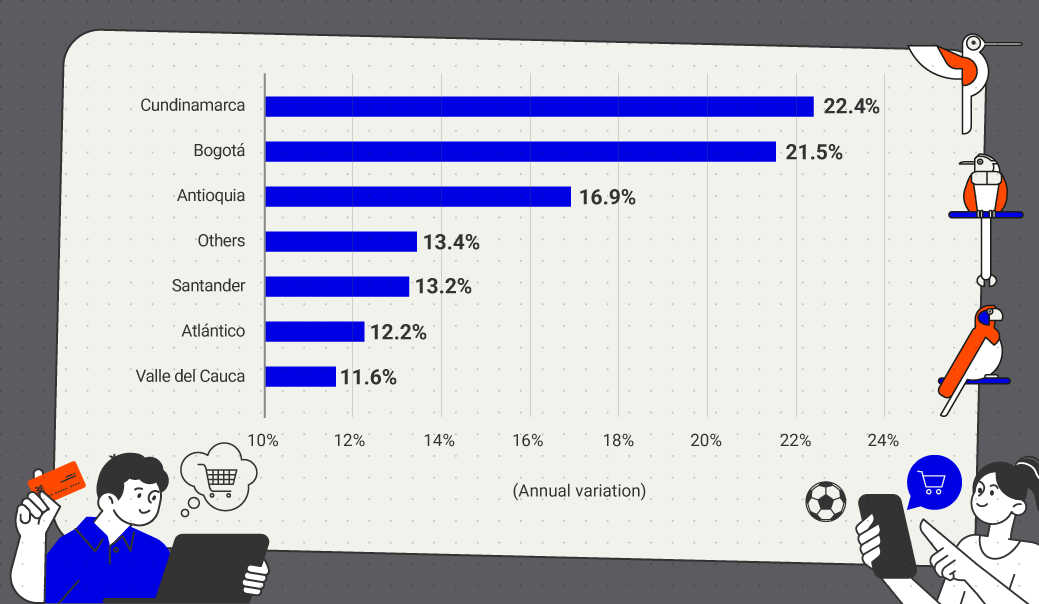
Source: Monthly Trade Survey (EMC for its Spanish acronym), National Administrative Department of Statistics (DANE for its Spanish acronym). Calculations by Banco de la República.
Not everyone found production easy
While commerce improved across the board, industrial production showed a more heterogeneous picture. Santander benefited from increased activity in fuel refining, and Boyacá grew again after several quarters of contraction, supported by sectors such as beverages, steel, and construction materials. In Valle del Cauca, production grew across several industries, including food, chemical products, and metallurgy. However, in Bogotá-Cundinamarca, industrial production fell slightly because growth in Cundinamarca did not offset the manufacturing decline in Bogotá, where some branches, such as textiles and clothing, recorded quarterly declines. In the Caribbean Coast, lower external demand and difficulty obtaining some inputs limited production in the departments of Atlántico and Córdoba.
Housing is still down
Although consumption was one of the quarter’s bright spots, residential construction was among the weakest areas. New home sales fell in every region compared with the same quarter a year earlier, as did some indicators related to new projects.
(second quarter of 2026)
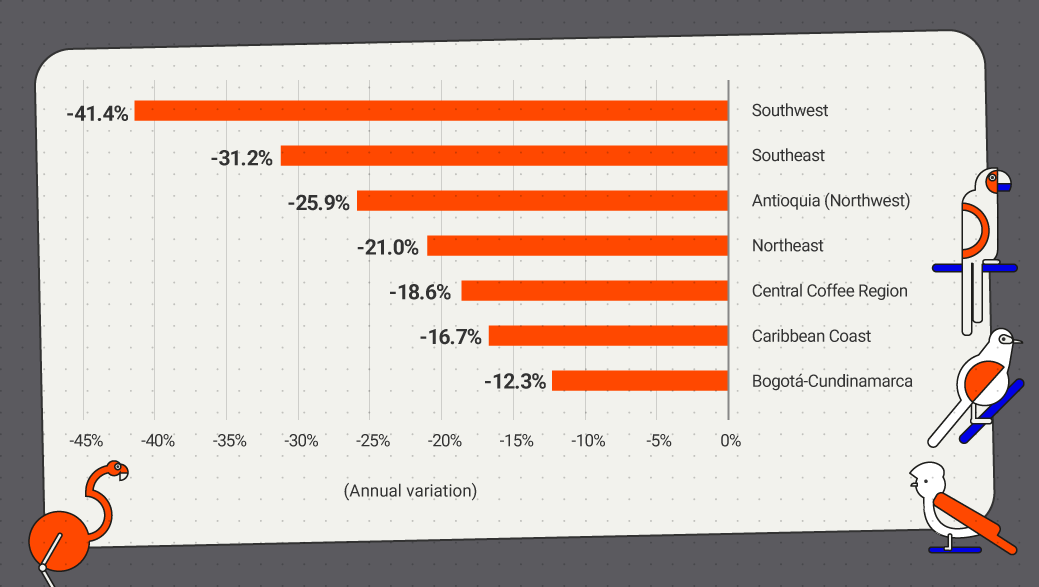
Source: Colombian Chamber of Construction (Camacol for its Spanish acronym). Calculations by Banco de la República.
In construction, it is necessary to differentiate between indicators and the type of works. In some regions, such as Bogotá-Cundinamarca, the Caribbean Coast, the Northeast, and the Southeast, fewer new homes were sold, but in the latter, the built area increased thanks to projects already underway. In Bogotá, conversely, slower housing momentum contrasted with the steady pace of civil works, including Line 1 of the Metro, the RegioTram, and Avenida 68.
Climate also influences the economy
In Colombia, discussing the regional economy also means addressing the climate. Although weather phenomena occur in specific places, their effects can be felt elsewhere. On the Caribbean Coast, the lack of rainfall reduced the supply of certain fruits, vegetables, and oil palm and also affected milk collection. In the Northeast, heavy rains and road blockades in April made it difficult to move livestock and affected the supply of perishables and palm products. In the Southwest, however, weather conditions were more favorable and helped increase production of sugarcane, coffee, and fruit trees. This illustrates how, when food production decreases or transportation is difficult, consumers may face higher prices.
Coffee and oil: two regions, two stories
Two products help explain why it is important to view the economy through a territorial lens: coffee and oil. In the Central Coffee region, coffee export values fell sharply because international prices fell and export volumes declined. Moreover, the harvest increased, and some producers preferred to accumulate inventories and wait for better prices before selling.
In the Southeast, oil production continued to decline, mainly because fields in Casanare underwent a natural decline and fields in Meta faced operational restrictions (associated with hiring local labor, union activity, and supplier availability in Meta fields) that limited output. The Rubiales and Acacias oil-producing fields partially offset this result. This occurred amid high international oil prices and geopolitical tensions in the Middle East, which favored the sector’s profitability.
Employment grew, but not all challenges disappeared
The labor market showed favorable signs in several regions. In Bogotá, Medellín, and the Central Coffee region, unemployment fell. However, growth was not uniform. Informal labor persisted in most regions, with the Central Coffee region and Villavicencio as exceptions, where informal employment declined. This reminds us that having a job isn’t enough; the type of job matters.
In the meantime, prices continued to rise
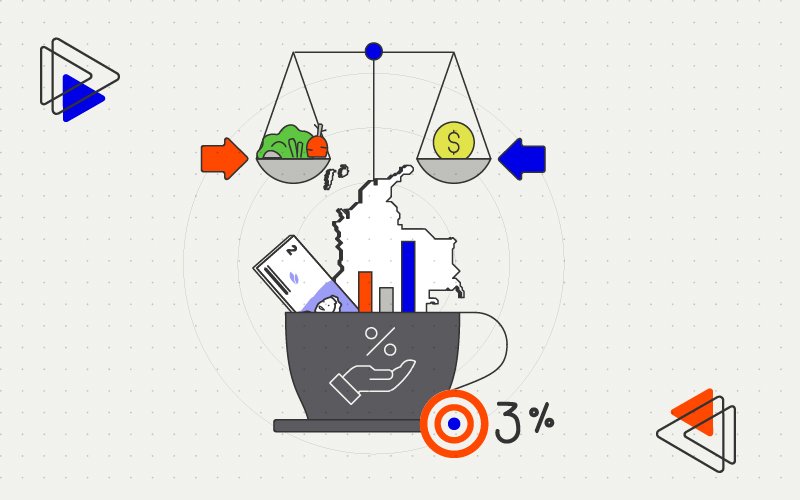
One last important piece of this regional picture is inflation. Across all regions, prices continued to rise. In Medellín and the Aburrá Valley, for example, service prices, including rents and those adjusted for past inflation or minimum-wage increases, were especially prominent. Perishable foods also exerted upward pressure. In Bogotá, inflation increased, although it remained below the national average. On the Caribbean Coast, food and accommodation contributed most to the price increase.
So, what is the second-quarter prognosis from a regional perspective?
The second quarter of 2026 left us with a clear lesson: Colombian regions progressed, but not uniformly. While consumption boosted activity in much of the country, residential construction continued to show weakness, and some sectors faced challenges associated with weather, international prices, or demand conditions.
For this reason, the regional perspective matters: it helps us understand not only how much the economy is growing, but also what is driving that growth in each territory. In a diverse country like ours, the Colombian economy tells more than one single story. Each region has a growth rate driven by its own activities and challenges. Together, these narratives explain the country’s overall economic results.
1 ↑ This analysis is based on information available for the second quarter of 2026. Therefore, it does not incorporate the economic effects of the August earthquake, whose impacts on productive activity, trade, employment, infrastructure, and living conditions in some regions will begin to appear in the economic indicators over the next few months. As new information becomes available, Banco de la República’s regional analyses will provide a more detailed assessment of this phenomenon’s aftermath in the affected territories.