The performance of a key variable as the unemployment rate (UR) over time reflects long-term trends and cyclical factors as well as specific episodes. The special section of the most recent Labor Market Report published by Banco de la República (the Central Bank of Colombia) analyzes this performance from a long-term perspective and emphasizes the impact that demographic change has had on the observed decline in the UR, using a period of slightly more than a decade as a reference.
Between the 2011–2013 and 2022–2025 three-year periods, the unemployment rate (UR) in Colombia declined from 10.6% to 9.8% nationwide, equivalent to an 0.8 percentage point decrease. In turn, the UR for the 23 main cities fell by 1.5 percentage points, from 11.5% to 10.0%. The analysis presented in the Labor Market Report quantifies how much of the observed change in the UR is explained by changes in each group’s demographic share of the population and how much is attributable to changes in employment and labor force participation within each age group. In other words, the analysis estimates how much of the observed decline in the overall unemployment rate is explained by demographic change and how much by other factors.
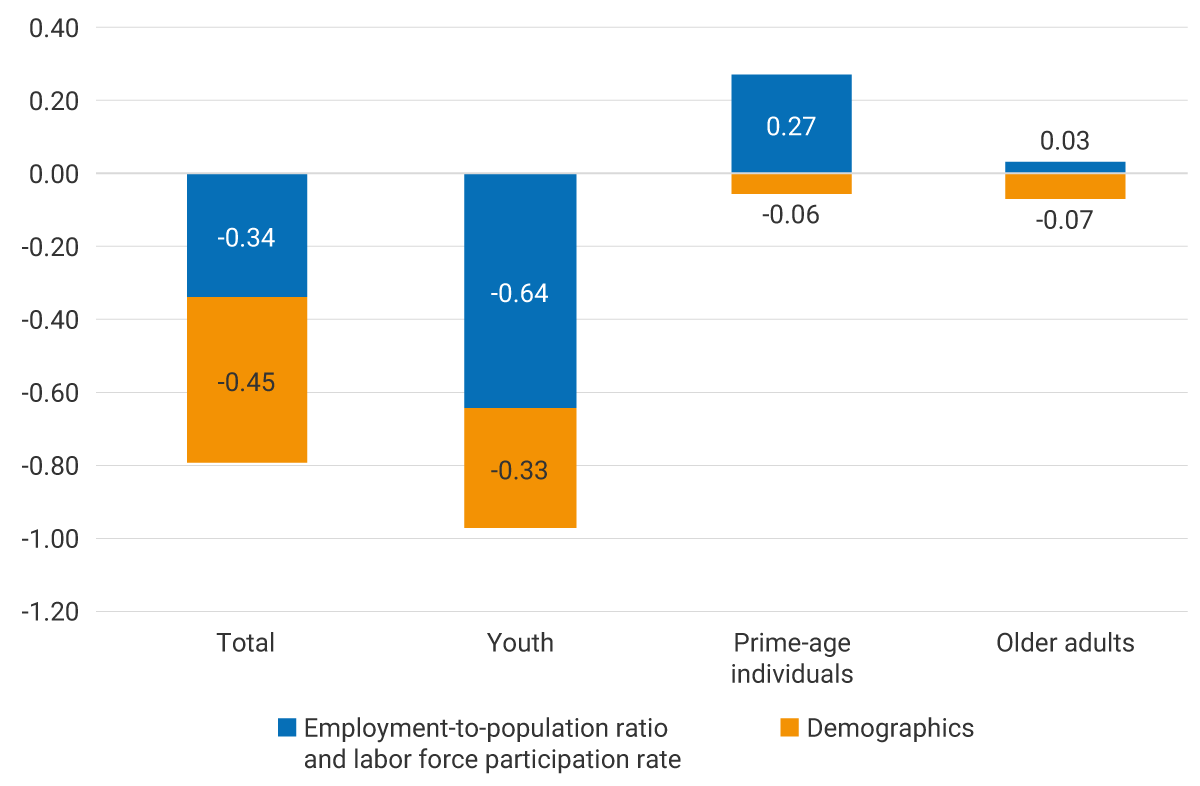
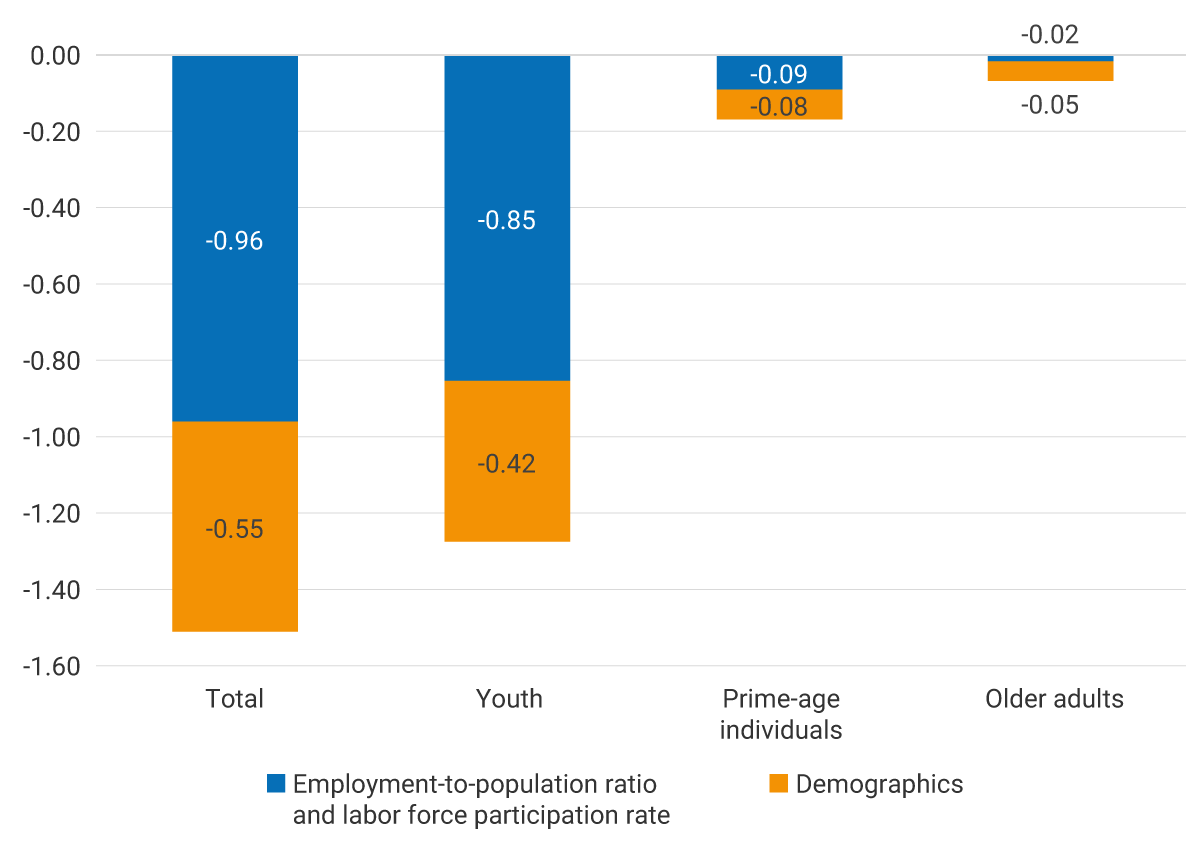
The first finding of the analysis is that a substantial share of the decline in unemployment is attributable to population aging. In the data, this aging process is reflected in the decline in the share of young people under the age of 28 in the working-age population, from 33% to 28% nationwide. Given that young people have historically experienced much higher unemployment rates than adults, the mere fact that they account for a smaller share of the population mechanically reduces aggregate unemployment. This demographic effect explains 0.45 percentage points of the total national decline of 0.8 percentage points. Likewise, this demographic change explains 0.55 percentage points of the total decline of 1.5 percentage points in the 23 main cities. This mechanism is expected to become more pronounced over the coming decades as population aging continues. Should the population projections of the National Administrative Department of Statistics (DANE in Spanish) materialize, by 2040 the UR is expected to decline by an additional 0.4 percentage points due to demographic change for the national domain and by 0.5 percentage points in urban areas.
A second finding concerns the decline in the UR explained by the combined effect of the labor force participation rate (TGP in Spanish) and the employment-to-population ratio (EPR) for each age group. The TGP corresponds to the percentage of the working-age population that chooses to participate in the labor market, thereby becoming part of the labor force, either by being employed or by actively seeking employment. In turn, the EPR corresponds to the percentage of the working-age population that is employed. Accordingly, if the TGP declines more than the EPR, unemployment will decrease, as a smaller share of the working-age population will be seeking employment without finding it.
In addition to the demographic effect mentioned above, the analysis shows that the TGP of the young population has declined. In other words, an increasing share of the young population is choosing not to participate in the labor market. Although this trend is partially offset by a lower EPR among young people, its net contribution to the decline in the UR is 0.64 and 0.85 percentage points for the national and urban domains, respectively.
Graphs 1 and 2 show these results for the national aggregate and the 23 main cities, respectively. The changes in the overall UR and by age group are presented for youth (18–25 years), prime-age individuals (26–65 years), and elderly adults (over 65 years). For each age group, the demographic change effect, and the combined effect on the EPR and the TGP are shown separately. As can be seen, the decline in the UR is concentrated in the youth segment and is explained by demographic factors and the combined effect of the EPR and the TGP. For the other age groups, the change is significantly smaller.
To understand why young people are participating less in the labor market, the document uses statistical decomposition techniques to identify the observed factors that contribute most to this decline. The most notable finding of this analysis is that the relative withdrawal of young people from the labor market is primarily associated with their level of educational attainment. Specifically, young people with higher levels of education (upper secondary and tertiary education) participate in the labor market much less than they did a decade ago.
The study highlights the importance of demographic change for understanding long-term labor market dynamics. More broadly, it underscores the importance of understanding the effects of demographic change and educational attainment across all areas of the economy.