5,000-peso Banknote - José Asunción Silva Commemorative Edition
Commemorative Edition dedicated to the poet José Asunción Silva
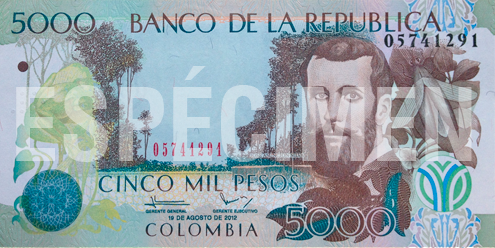
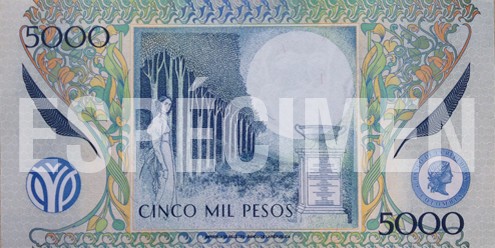
The 5,000-peso banknotes paying tribute to José Asunción Silva the greatest of our poets, were introduced on 22 September 1995.
The Bank wanted to recognize that, for Colombians today, Silva is the central figure of Colombian poetry, the founder of the poetic trends that have come down to us today, and the author of poems that are already part of our psyche and our cultural heritage, like Nocturno.
Special recognition from the Bank is due to Juan Cárdenas, author of the design of the main motifs for this banknote, and to the people from Colombia and abroad who worked together to bring this new banknote into circulation.
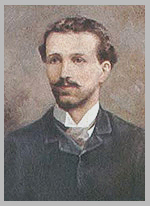
José Asunción Silva
Recognized as the most important and universal poet in the history of Colombian literature, Silva was born to Don Ricardo Silva and Doña Vicenta Gómez in Bogotá on 27 November 1865. His father, a wealthy merchant of imported luxury goods and a hobbyist costumbrist writer, transmitted an interest in literature, a taste for a refined life and a particular sense of detachment from society to him.
José Asunción was the oldest of six brothers and sisters. Three of those who followed him died very young. Julia, the youngest, was the only one that survived. His fourth sister, Elvira, who awakened a special affection in the poet and came to be considered the most beautiful woman in Bogotá, died in 1891, leaving an indelible mark on Silva. He wrote the famous Nocturno III in her memory in 1892 and it was published in 1894. Today, it is rightly considered to be the greatest poem in Colombian literature.
Young José Asunción's schooling took place in three private schools for short periods of time. He showed a marked inclination for learning and art, and as early as the age of twelve, he aroused the jealousy and ridicule of his peers for his peculiar habit of wearing European velvet suits, satin ties, and a silver watch, and for his unusual ivory case with business cards.
He complemented his local education with readings of the French Romantics while working in his father's store as errand-boy and clerk since he was thirteen years old. Don Ricardo, who held pleasant get-togethers at his home with the main intellectuals in Bogotá, dedicated the book Artículos de costumbres to his eldest son in 1883. It was the only one he published four years later. He would die leaving numerous debts and the family finances in ruins.
At the age of ten, Silva wrote The First Communion. Seven years later he published his first translation from French in the Papel Periódico Ilustrado. Up until the age of eighteen and before travelling to Europe, he submitted verses to a few periodicals and wrote a volume entitled Intimidades (Intimacies).
The trip to Europe took place in 1885 when he was 20 years old. He returned to Bogotá in 1886, having become a refined and sensitive dandy, imbued with the French avant-garde of impressionist painters, naturalist novels, and symbolism. In 1886 he contributed eight poems to the anthology La lira nueva (The New Lyre) to which some of the young poets of the time contributed. His verses also appeared in Parnaso colombiano (Colombian Parnassus), another important anthology. These were the only two books in which he published his poetry during his lifetime.
He became friends with Baldomero Sanín Cano and, upon don Ricardo’s death in 1887, he discovered that the civil war of 1885, the introduction of paper money, the instability of the exchange rate, and the high interest rates had seriously weakened the family economy. After a short life as a wealthy young man in Europe, where he honed his artistic tastes, he was faced with the urgency of supporting his mother and two sisters. While writing, he always hid his economic difficulties and never changed his aristocratic ways, his refined tastes, and his aloofness to the society in Bogotá, which viewed him with suspicion. "Everything about him breathed distinction and rarity," wrote the poet Guillermo Valencia.
He had to face 52 lawsuits. In reality, Silva inherited a bankruptcy that, despite his best efforts, he never managed to solve. Appointed by Miguel Antonio Caro, he went to Caracas in August 1894 to work as a secretary in the Colombian diplomatic mission. This provided him with temporary financial relief. There he devoted himself to office work, to writing poems and to his only novel, De sobremesa, which was essentially a self-portrait of the author. For unknown reasons he applied for a leave of absence in 1895. The steamer in which he was returning sank off the Colombian coast. The lives of the passengers were saved, but not their luggage. It is said that Silva lost a trunk containing the best of his work, written in Caracas.
Back in Bogotá, he applied himself to the establishing of a factory to make colored tiles, which were very popular in Venezuela. At the same time, he rewrote some of the lost writings, including the novel and the Book of verses. Excited by the budding industrial venture, he did not accept another diplomatic post in Central America. But the people of Bogotá were not interested in tiles and mosaics. He dissolved the company and with it the illusion of regaining economic wellbeing.
On 23 May 1896, he met with a few friends at his residence in the evening. The same day, a doctor, Juan Evangelista Manrique, after an examination and at the request of the poet, had marked the place where his heart was located with a cross on his chest. The next day, a Sunday, Silva was found dead in his bed. He was not yet 31. A revolver was lying in the blankets. Gabriel d'Annunzio's “The Triumph of Death” laying on the bedside table caught one’s eye. He had spent the last four pesos he had in the bank on a bouquet of flowers for Julia, his youngest sister.
His death gave birth to a legend. He never published a book with his poems, which were little known in Bogotá and recited by heart by some of the people in Cartagena and Caracas. They began to be published in different editions from 1908 onwards. The Libro de versos, De sobremesa, and Prosa appeared in the twenties with some censorship dictated by the decorum of the time. According to Unamuno, his literary innovation was an inner rhythm. His entire production fits into less than four hundred pages that have been studied and commented on in several volumes of greater length.
José Asunción Silva’s poetry was the beginning of modern literature in Colombia. It can be read today, 99 years after his death, as if it were the work of a contemporary.