Quarterly Update of the Financial Stability Report – April 2026
The main purpose of these documents is to provide semiannual information on the vulnerabilities and risks of the financial system. The views presented and potential errors are the sole responsibility of the authors and their contents do not compromise the Board of Directors of Banco de la República
Amid stronger economic activity, higher inflation expectations, and persistent risks related to the Colombian government’s fiscal position, the April 2026 quarterly update of the Financial Stability Report highlights the following vulnerabilities in the local financial system and their mitigating factors.

Exposure of financial intermediaries to an environment of tighter local financial conditions:
- Margins and profitability of credit institutions (CIs) have been recovering consistently, in line with the recovery in loan portfolio growth and declining delinquency rates.
- Tighter financial conditions could weigh in on the recovery of financial institutions' profitability due to higher financing costs.
- Collective investment funds portfolios could also face valuation losses on certificates of deposit (CDs) amid higher interest rates anticipated by the market.
- However, these entities maintain ample liquidity buffers, enabling them to withstand adverse scenarios.

Increase in market risk exposure:
- Financial institutions have increased their investments in local public debt instruments, which could heighten their vulnerability to price shocks in a fiscally challenging environment.
- However, banks maintain high levels of hedging in these markets, and market risk indicators for both banks and non-bank financial institutions remain at moderate levels.

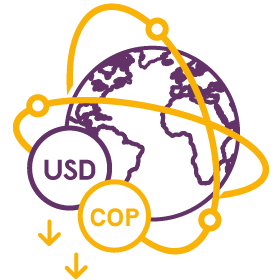
Exposure to a sharp depreciation of the Colombian peso:
- A sharp depreciation of the Colombian peso vis-a-vis the U.S. dollar, amid heightened global uncertainty, could increase financial pressures on the Government and on firms with foreign currency debt, which could be transmitted to financial institutions.
- However, this risk is limited for most firms, as they have mitigation mechanisms in place. Additionally, CIs are subject to regulations that result in low direct exposure to exchange rate risk.
Uncertainty regarding regulatory changes:
- The regulatory framework governing financial institutions plays a fundamental role in shaping the development of their operations.
- The potential implementation of regulatory initiatives that create uncertainty about the rules governing financial institutions could have adverse effects on financial markets and their intermediaries.

 Reports and Updates
  Boxes
Boxes  Press Releases